
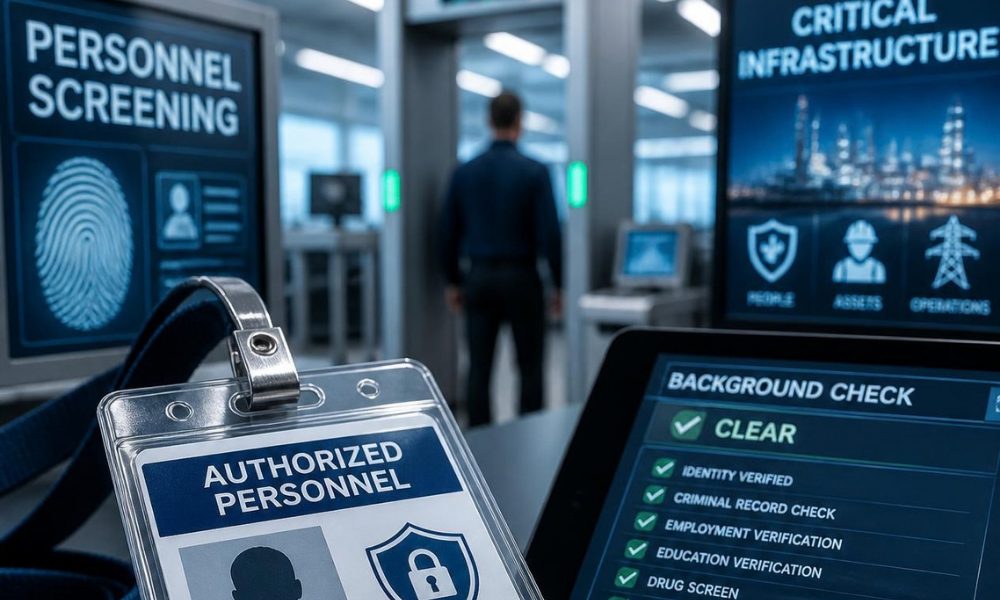
For a staffing firm, every placement carries your name. When a worker you sent to a client's data center build, substation crew, or plant floor turns out to have falsified credentials or a relevant record, the client doesn't blame the individual. They question your process. And when the client runs critical infrastructure, the person you placed may hold a badge, keys, or system access to an asset that cannot afford to fail. Background screening is therefore a core risk-management function, and a defensible one can be the difference between a trusted staffing partner and a costly liability.
This article covers what a sound screening program includes, the legal framework that governs it, and how to build a process that works at staffing speed.
Why screening matters more in staffing
Staffing and HR teams face pressures that in-house employers often don't. Volume is high and timelines are short, since a client may need 40 workers by Monday. You also sit between two parties: the candidate, who has legal rights under federal and state law, and the client, who expects a safe, qualified worker. A mistake in either direction creates exposure. Skipping or rushing screening invites negligent hiring and negligent retention claims. Misusing screening results invites discrimination and Fair Credit Reporting Act (FCRA) claims.
Global Verification Network (GVN) frames this well: staffing firms act as gatekeepers in the hiring process, and a thorough, compliant background check has become a hallmark of a high-quality recruiting firm.
When the client is a critical facility
Placements at energy, data center, and industrial sites add a layer the standard staffing package doesn't cover: the client's own access program. In the electric sector, NERC's personnel standard (CIP-004) requires a personnel risk assessment, including identity confirmation and a seven-year criminal history check, before a worker is granted authorized electronic or unescorted physical access to covered systems. Data center and industrial owners may write comparable requirements into their contractor agreements. Ask each client what its access program requires before you build the package, not after the first worker is turned away at the gate. For the asset owner's side of this, see Personnel Screening: The Overlooked Layer in Critical Infrastructure Protection.
What a due diligence-based screening program includes
Due diligence means matching the depth of screening to the risk of the role and documenting why. A typical staffing package, as outlined by GVN's staffing screening program, draws from these components:
Social Security number trace (address/alias history). This identifies where a candidate has lived and under what names, which tells you which jurisdictions to search. It is not an identity verification on its own.
Criminal record searches. Searches at the county, state, and federal levels. Relying on a single national database alone is a common source of gaps and errors, so county-level searches in the candidate's jurisdictions remain important.
Employment verification. Confirms titles, dates, and responsibilities, and flags inconsistencies in work history.
Education verification and professional license verification. Resume inflation is common, and for licensed or credentialed roles, an unverified credential is a direct liability.
Drug testing. Appropriate for safety-sensitive positions, though state and local laws on what and when you may test vary.
Motor vehicle records and reference checks. Essential for driving roles, and useful for assessing reliability and conduct.
Credit reports. Use these sparingly. Many states restrict employment credit checks, and they should be tied to roles with genuine financial responsibility.
The principle that ties these together is job-relatedness. A package built for a forklift operator should differ from one built for a data hall technician with badge access or a bookkeeper. Screening everyone for everything adds cost and legal risk without adding protection.
The legal framework you must get right
Screening is heavily regulated, and many claims come from process errors rather than the results themselves.
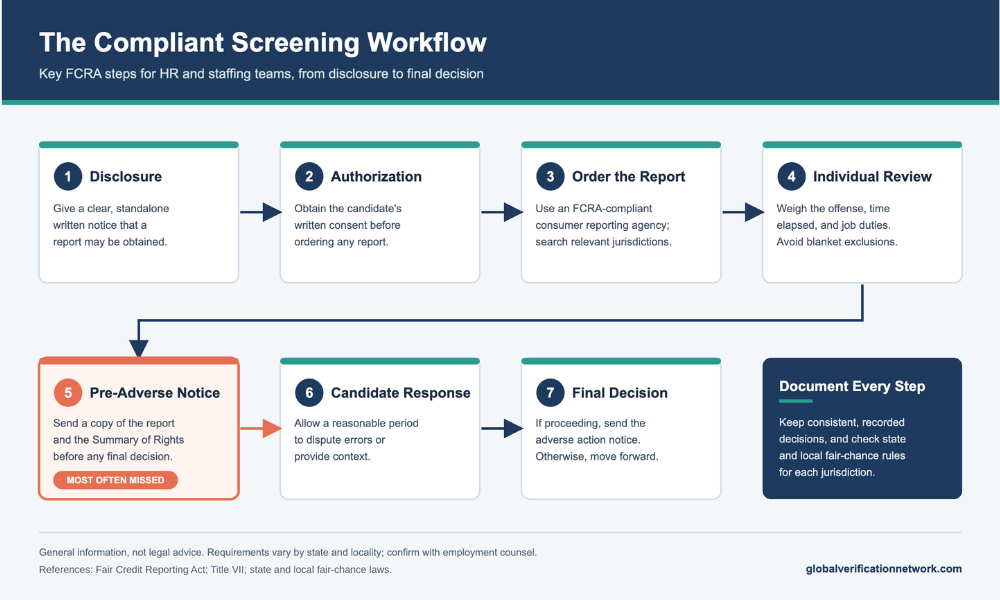
The Fair Credit Reporting Act (FCRA). When you use a third-party consumer reporting agency, the FCRA applies. In broad terms, you must:
Give the candidate a clear, standalone written disclosure that a report may be obtained.
Obtain the candidate's written authorization.
Certify to the screening company that you have a permissible purpose and will comply with equal opportunity laws.
If you may take adverse action based on the report, send a pre-adverse action notice that includes a copy of the report and the FCRA Summary of Rights, and give the candidate a reasonable opportunity to respond.
If you proceed, send a final adverse action notice.
Skipping the pre-adverse step is a frequently litigated FCRA error in employment screening. The FTC and the CFPB publish employer guidance, and the CFPB publishes the standard Summary of Rights form.
Title VII and criminal history. Title VII still prohibits discrimination in hiring, and a blanket "no records" policy can still draw disparate impact claims from private plaintiffs. In late October 2026 the EEOC rescinded its 2012 Enforcement Guidance on the Consideration of Arrest and Conviction Records and has stepped back from disparate impact enforcement, but the rescission does not change the statute or stop private suits. The factors courts have long applied to test whether a criminal-history exclusion is job-related remain a sound review standard: the nature and gravity of the offense, the time elapsed, and the nature of the job. An arrest that did not lead to conviction is not proof of conduct and should be treated very differently from a conviction.
Ban-the-box and fair chance laws. Many states, cities, and counties restrict when in the hiring process you can ask about or consider criminal history, and several require their own individualized assessment and pre-adverse notice, regardless of what federal agencies do. If you place workers across jurisdictions, a single national workflow is rarely enough. Your process needs to adapt to local requirements. The National Employment Law Project tracks these laws, and you should confirm current requirements with counsel since they change often.
State-specific rules. Several states add their own requirements on top of the FCRA, including restrictions on credit checks, limits on reporting older records, and additional disclosure rules. Look-back periods for reporting certain information also vary.
Employment eligibility. Form I-9 verification is separate from background screening, and E-Verify, where used, has its own timing rules. It generally takes place after an offer and completion of the I-9, not as a pre-offer screen. Review the program rules at E-Verify.gov.
This is general information, not legal advice. Have employment counsel review your screening policy and forms.
Common pitfalls that create liability
Inconsistent application. Running different checks for similar roles, or applying criteria unevenly, is a classic fact pattern in discrimination claims.
Blanket exclusions. Automatic disqualification for any criminal record, without individualized review, is risky.
Treating arrests like convictions. This is a frequent compliance trap.
Misusing credit data. Credit history should be relevant to the job, not a default check.
Incomplete or defective disclosures. Cluttering the FCRA disclosure with extra language or liability waivers has repeatedly drawn litigation.
Ignoring adverse action procedures under time pressure.
Poor recordkeeping. If you can't show what you screened and why, you can't defend the decision.
Building a defensible, scalable process
1. Write a screening policy. Define which checks apply to which job categories, the look-back periods you use, and who decides on borderline findings. Review it annually.
2. Tier your packages by role risk. A few standardized packages (for example, light-industrial, office, driver, licensed professional, executive) keep screening consistent and fast.
3. Use an accredited consumer reporting agency. Look for accreditation through the Professional Background Screening Association (PBSA), FCRA expertise, county-level court research, clear turnaround times, and support that helps you interpret results. GVN states that its team is FCRA-certified, with senior leadership holding advanced FCRA certification, and that it works with staffing clients to tailor workflows to volume and role types. Whichever vendor you choose, ask for specifics on how they handle accuracy, disputes, and jurisdiction-specific rules.
4. Train your recruiters. The people who handle disclosures, review results, and talk to candidates need to understand adverse action steps and what they can and cannot say or ask.
5. Build in an individualized review. Create a simple, documented process for evaluating records against the job: what the offense was, how long ago, and how it relates to the duties.
6. Offer candidates a way to dispute. Accuracy protects everyone. Candidates have the right to challenge errors, and a fast dispute path prevents wrongful rejections.
7. Protect the data. Background reports contain sensitive personal information. Limit access, store securely, and dispose of records in line with applicable retention and disposal requirements.
8. Audit regularly. Review a sample of decisions for consistency, check turnaround times, and update forms and workflows when laws change. An independent review of the program is worth considering at least periodically.
Beyond the pre-hire check
Risk doesn't end at placement. For longer assignments, safety-sensitive roles, or workers who hold access at a critical site, consider whether periodic rescreening is appropriate and permitted in the relevant jurisdictions, and make sure candidates receive the proper disclosures and authorizations. Also be clear with clients about who is responsible for what. Staffing agreements should spell out which screenings you perform, which the client may require on top, who removes a worker's access when an assignment ends, and who bears responsibility for decisions made on the results.
The bottom line
A strong screening program protects three things at once: your clients' workplaces, your candidates' rights, and your own reputation. The firms that do this well don't just run more checks. They run the right checks for each role, apply them consistently, follow the legal steps precisely, and document their decisions.
For more detail, GVN's Staffing Company Background Check Guide goes deeper on staffing-specific compliance, and the main site lists their full range of verification, due diligence, and investigative services.
Disclosure. Global Verification Network and Amidon are both affiliated with Preservation 2, and GVN's screening services are offered through Amidon. Read references to GVN with that in mind. About and disclosure.
This article is provided for general informational purposes only and does not constitute legal advice. Background screening laws, including the Fair Credit Reporting Act and state and local fair chance requirements, vary by jurisdiction and change frequently. Consult qualified employment counsel regarding your organization's specific screening policies and practices.
To talk through personnel screening as part of a protection strategy, request an assessment.